

Best RC Servo Brands for Racing: 2026 Guide
Table of Contents
- Best RC Servo Brands for Racing: What Actually Decides the Win
- Brushless RC Servo for Racing: Worth the Upgrade?
- How to Choose an RC Racing Servo: Spline, Torque and Fit
- The Part That Actually Wins Races
- Picking the Right Combination
- Frequently Asked Questions
Last Updated: October 8, 2026
Best RC Servo Brands for Racing: What Actually Decides the Win
The best RC servo brands for racing are judged on torque, transit speed, and spline fit, not the logo. We find that drivers lose more time to a flexing arm or mismatched spline than to raw torque.
Below: what separates a race-grade servo from a basher unit, when a brushless RC servo for racing is worth it, and how to match spline, torque and offset to your chassis.
Brushless RC Servo for Racing: Worth the Upgrade?
A brushless RC servo for racing is worth it for faster centring and cooler running under repeated load, since electronic commutation means no brush wear. It matters most in the long mains of 1/8 scale to the high-grip tracks of 1/10 scale; a coreless or brushed servo still holds its own in budget club racing. The catch: a brushless servo exposes slop elsewhere, so pair it with a rigid alloy arm.
How to Choose an RC Racing Servo: Spline, Torque and Fit
Choosing an RC racing servo comes down to spline count, torque rating, and physical fit. Get the spline wrong and the arm will not seat; get the torque wrong and you either stall the servo or carry dead weight.
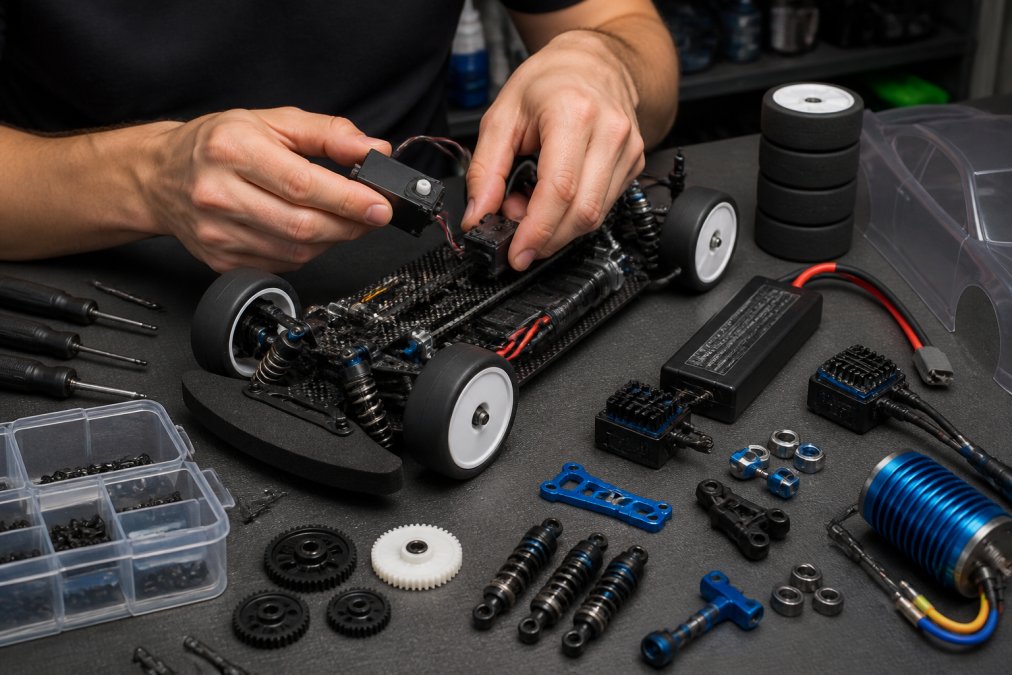
Close-up of a racer's hands fitting a black alloy clamping servo arm onto a servo spline on a 1/10 scale touring car chassis, tools and setup board visible on a pit table
Start with the spline: Futaba-spec servos use 25T, Sanwa and KO use 23T. They are not interchangeable, and forcing an arm onto the wrong spline strips the teeth.
Then match the arm to the job. The table below maps our Aerox arms to their fit and offset.
Servo Arm |
Spline |
Hole Distances |
Offset |
Best For |
|---|---|---|---|---|
AX062 clamping arm |
18mm and 21mm |
3mm |
Touring car steering, LD3 builds |
|
AX031 offset arm |
25T Futaba |
17mm and 19mm |
5.6mm |
Touring and off-road |
AX030 offset arm |
23T Sanwa |
17mm and 19mm |
5.6mm |
Touring and off-road |
Torque is second: an oversized servo adds weight and current draw, so pick a rating that holds full lock without stalling, then set endpoints so the servo is not fighting the steering stops.

Schumacher Aerox AX062 7075-T6 alloy clamping servo arm - 25t Futaba
RC servo speed vs torque: which matters more?
Speed wins on tight, technical tracks; torque wins on high-grip surfaces and heavier off-road cars. For most 1/10 scale racing, a balanced servo beats an extreme one-trick unit.
What is the best servo for 1/10 scale RC racing?
The best servo for 1/10 scale RC racing is a mid-size unit with a 25T or 23T spline matching your radio brand, enough torque to hold full lock without stalling, and a metal-gear train.
The Part That Actually Wins Races
Most buying guides rank servos by spec sheet alone. In practice, the arm and clamping screw transfer every bit of that torque to the wheels, and a slipping arm throws away the servo's advantage.
Schumacher Aerox AX062 7075-T6 alloy clamping servo arm - 25t Futaba →
That is why we stock the Aerox alloy arm range alongside the servos. Each arm is cut from 7075-T6 alloy with a high-tensile steel clamping screw, so it grips the spline instead of rocking on it. The AX062 25T Futaba clamping arm uses a 3mm clamping screw with a 2mm hex fitting, with holes at 18mm and 21mm from the spline centre.
For 23T Sanwa, the AX030 offset arm uses the same 7075-T6 construction with holes at 17mm and 19mm and a 5.6mm offset. The AX031 25T offset arm covers FT8, FT9, Mi8 and Mi9, and the AX012 handles KO and Sanwa 23T fitments across the CAT PB and Mi7.


For laydown buggies, the AX010 23T arm places its holes at 15.5mm and 21mm and suits the LD2, LD3, KC and Storm ST.
Picking the Right Combination
Buy the servo and the arm as one decision. A fast brushless unit on a flexing plastic arm performs worse than a modest servo on a rigid alloy arm.
Our rule of thumb for racers building or refreshing a car:
- Confirm your servo spline: 25T Futaba or 23T Sanwa/KO
- Check the arm hole distances match your steering geometry
- Verify the offset clears the top deck and body
- Match torque to surface grip and car weight
- Replace the clamping screw if the arm has been on and off several times
- Set endpoints so the servo is not stalling at full lock
Run through that list before your next meeting and you remove the most common source of steering inconsistency.
Frequently Asked Questions
What are the best RC servo brands for racing?
The right brand depends on your chassis and spline, not a single winner. Look for brands like HiTec, KO Propo & SRT that publish consistent torque and speed figures and offer servo arms that match your car. Schumacher's Aerox range covers 23T and 25T splines with 7075-T6 alloy clamping arms, so you can match a servo to a proven arm rather than guessing fit. Prioritise brands with stable batch quality, clear specs, and arms designed for your specific chassis.
Is servo speed or torque more important for RC racing?
It depends on the class. Touring car racing on high-grip tracks rewards fast transit times, so speed matters most. Off-road and heavier cars need torque to hold steering under load. For most 1/10 scale racing, a servo with roughly 0.08 to 0.10 second transit and enough torque to resist kickback is a solid baseline. Match the spec to your surface, not to the biggest number on the box.
Are brushless servos worth it for RC racing?
Brushless servos hold their centring better over long mains and run cooler than brushed equivalents, which matters in back-to-back heats. They also tend to keep consistent speed as the pack drains. The trade-off is cost and the need for a compatible radio and BEC setup. If you race weekly and notice steering fade late in a run, a brushless RC servo for racing is a reasonable upgrade.
Steering feel is one of the few things you can genuinely control between race meetings, and it starts with parts that fit and hold. Track Star R/C stocks Schumacher race cars with World Championship heritage alongside a curated range of specialized R/C components, with Certified True CST batch consistency so the part you order next month matches the one you fitted last month. Browse the Aerox servo arm range and get your steering locked in before the next round.